
21 April 2026 – QuotaClimat, Data For Good and Science Feedback are publishing a new report on the state of climate misinformation on television and radio in four countries – France, Spain, Poland and Brazil – covering a total of 44 media outlets. Of the 815 instances of climate misinformation identified, 85% were detected in private media outlets. Misinformation is no longer limited to the denial of science, but directly attacks climate action by exploiting the associated costs. In Europe, renewable energy is among the most targeted topics.
Lire le rapport (Français)│Leer el informe (Español)│Read the key takeaways (Polski) │Read the key takeaways (Português)
This report has been produced as part of a collaboration between QuotaClimat, Science Feedback and Data for Good, aimed at semi-automatically detecting climate misinformation in the broadcast media. The methodology and data analysis were carried out in collaboration with fact-checking organisations specialising in the national context under study: Lupa (Brazil), Maldita.es (Spain), Science Feedback (France) and Demagog (Poland). In France, the results are available on the Observatoire des Médias sur l’Ecologie.
Uneven exposure across countries and heavily concentrated in certain media outlets
Analysis of 7 Brazilian channels, 6 Spanish channels, 18 French channels and 13 Polish channels reveals varying levels of exposure to climate disinformation across countries: 665 cases of climate misinformation were detected in France, 54 in Poland, 76 in Brazil and 20 in Spain. 85% of cases were detected in private media outlets.
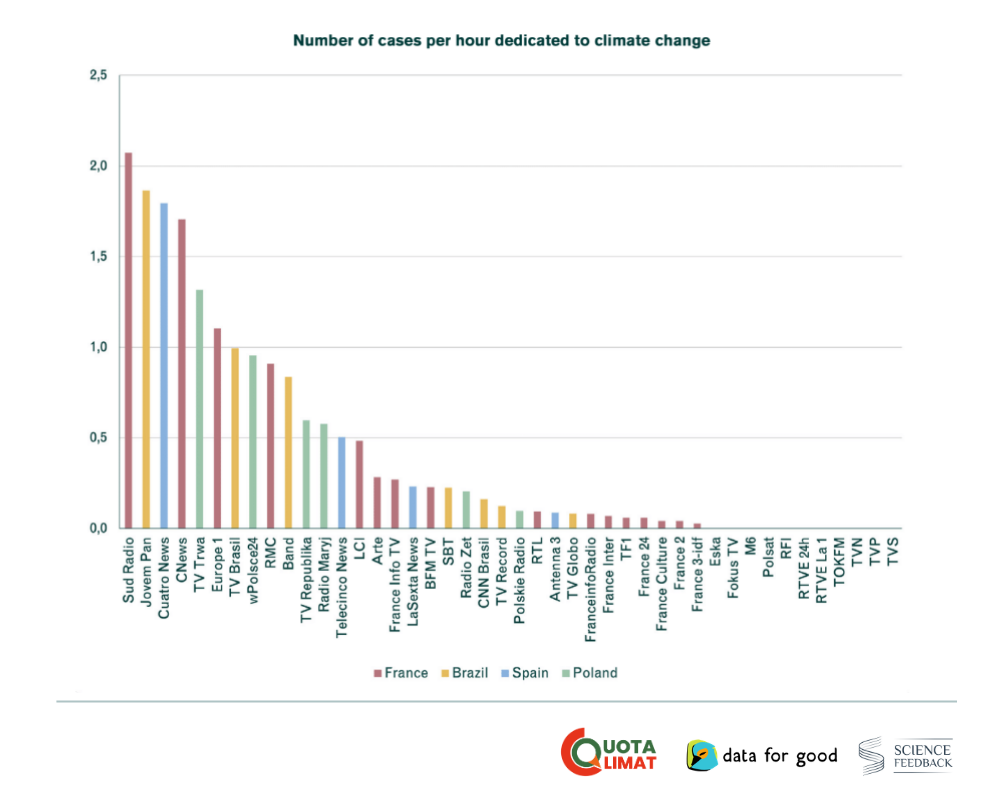
National exposure to climate disinformation is also heavily skewed upwards by a limited number of channels:
- 14 media outlets broadcast more than one instance of disinformation for every two hours of airtime devoted to environmental issues: Sud Radio, Jovem Pan, Cuatro News, CNEWS, TV Trwa, Europe 1, TV Brazil, wPolsce24, RMC, Band, TV Republika, Radio Maryj, Telecinco NEWS and LCI.
- Five of the 14 media outlets concerned are French, four are Polish, three are Brazilian, and two are Spanish.
- In France and Poland, rolling news channels appear to be more susceptible to disinformation than general-interest channels.
The report also shows that, generally speaking, the more media outlets cover climate-related topics, the fewer instances of misinformation they disseminate. Three media outlets are exceptions: SudRadio, TV Brasil and Trwa, which are particularly exposed to disinformation whilst providing relatively extensive coverage of the topic.
Climate disinformation occurs during strategic political moments or extreme weather events
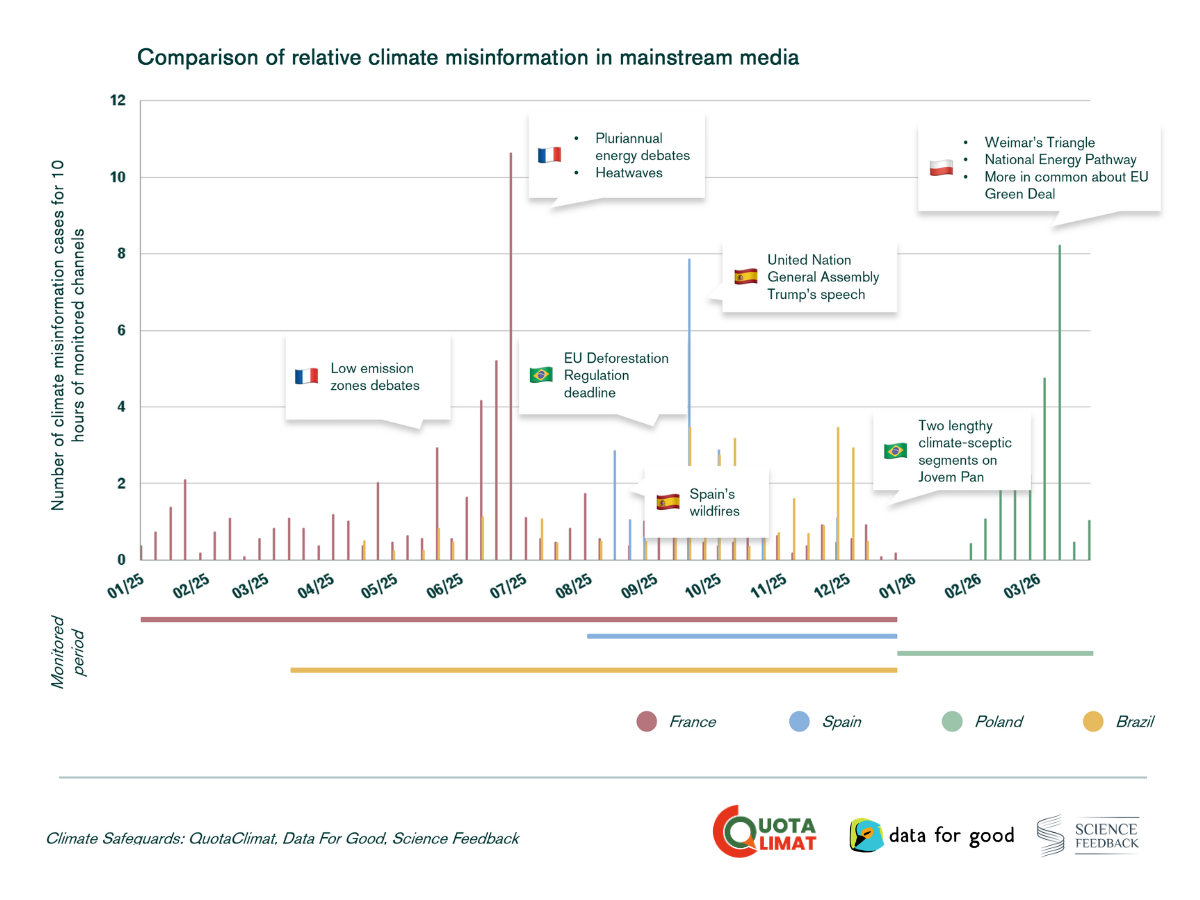
Between January 2025 and March 2026, four periods conducive to climate disinformation were identified:
- debates on environmental public policy, such as discussions on low-emission zones or multi-year energy planning in France, the publication of the new national energy roadmap in Poland, or the entry into force of the European regulation on deforestation in Brazil.
- major international and European events, such as the Weimar Triangle summit in Poland.
- extreme weather events, such as the heatwave in France or the forest fires in Spain.
- statements by influential figures, notably Donald Trump’s speech at the United Nations.
Renewable energy at the heart of disinformation narratives in Europe
These narratives revolve around four main themes:
- sovereignty: renewable energy is portrayed as an external intrusion dictated by urban or foreign decision-making centres;
- opposition to the European Union, often portrayed as the ‘mastermind’ behind a punitive transition, imposing standards disconnected from on-the-ground realities;
- industrial and social decline: renewable energy is linked to the disappearance of traditional industries (coal, nuclear, combustion-engine vehicles) and rising energy prices;
- anti-elite sentiment: wind turbines are used as a symbol of an “out-of-touch” elite imposing its aesthetic and moral values.
In France, more than half of the cases detected relate to renewable energy. Most of these cases claim that renewable energy is causing electricity prices to skyrocket, which is misleading, or that it is inefficient due to its intermittency, which is unfounded.
In Poland, peaks in disinformation coincide with major European events and draw more heavily on narratives of industrial and social decline and anti-European Union sentiment than in the other countries analysed.
In Spain, climate disinformation remains limited in the media analysed. This is partly due to the limited number of rolling news channels and the regular presence of experts in environmental debates. The report does, however, highlight a susceptibility within the media to the ‘chemtrails’ conspiracy theory, which stands in contrast to the other countries studied. The forest fires of summer 2025 also led to instances of misinformation denying the link between global warming and the fires or accusing renewable energy of causing them.
In Brazil, climate disinformation is frequently linked to pro-agribusiness narratives, promoting domestic agriculture and livestock farming. The denial of climate change and its human origins also occupies a more prominent place in the media there than in the other contexts studied.
Four recommendations to strengthen the integrity of information
This analysis reveals a vulnerability of the media to disinformation narratives, at the risk of amplifying their impact on public debate. To strengthen the integrity of climate information within traditional media, four key recommendations are put forward:
- Training journalists in new narratives of obstruction;
- A more careful selection of panellists on television programmes to ensure expertise is represented;
- Daily and regular coverage of environmental issues;
- The establishment of an accountability framework for those spreading disinformation.
Scope of the report
This report covers news programmes on the following channels:
- Spain: RTVE La 1, RTVE 24h, Antena 3, Cuatro News, Telecinco News, La Sexta News
- France: TF1, France 2, France 3 Ile de France, M6, France 24, France Info TV, CNews, LCI,
BFMTV, Arte, RMC, RTL, France Inter, France Culture, France Info Radio, RFI, SudRadio - Poland: Fokus TV, Polsat, Polskie Radio, Radio Maryja, Radio Zet, TOKFM, TVN, TVP,
TV Plus, TV Republika, TVS, TV Trwam, wPolsce24 - Brazil: Band, CNN Brasil, Jovem Pan, SBT, TV Brazil, TV Globo, TV Record
The periods analysed by country are as follows:
- March–December 2025 in Brazil
- August–December 2025 in Spain
- January–December 2025 in France
- January–March 2026 in Poland