

Our purpose
At QuotaClimat, together with all our partners, we quantify and qualify how the media cover environmental crises.
Producing reliable, reference-grade data lets us move past received wisdom, ground our findings in fact, and look for solutions that fit.
This grounding in fact is now a precondition for action, and that holds for everyone involved in the media debate:
- Civil society and NGOs, to raise awareness, make our voices heard by institutions, and put solutions forward.
- Citizens, to better understand the media that inform them daily and to speak up alongside us.
- Public authorities, regulators, and lawmakers, because grounding decisions in reliable data is essential.
- Media, journalists, editors, and shareholders, to identify internally where things can improve.
Are you one of these actors and would like access to a specific analysis? Get in touch.
Our data projects
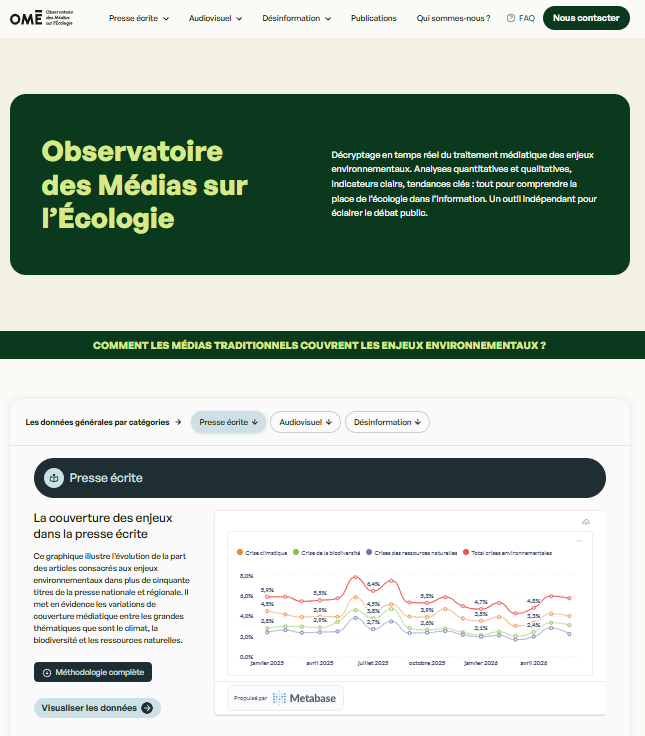
The Media Observatory on Ecology (L’Observatoire des Médias sur l’Ecologie)
The Observatory (OME) is the first flagship data project we co developed with all our partners: Data For Good, éclaircies, eleven, Expertises Climat, Mediatree, Pour plus de climat dans les médias, and Science Feedback.
Its aim is to establish, in factual terms, how so called “traditional” media cover environmental issues: television, radio, and print.
In particular, it lets us:
- Measure media coverage of environmental issues
- Monitor climate misinformation in French media
- Quantify the advertising pressure of polluting sectors in the media
Belgian Barometer of Environmental Information
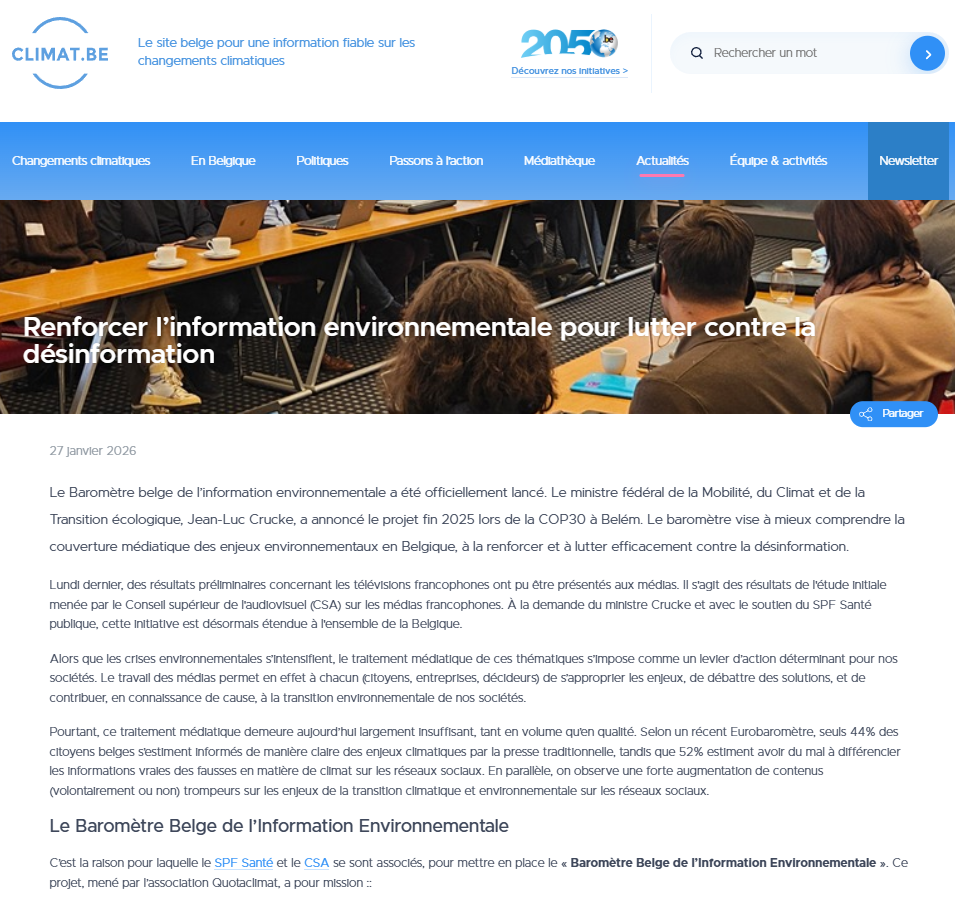
The Barometer (BBIE) replicates the Observatory in Belgium. It was initiated by the SPF Santé publique, Sécurité de la Chaîne alimentaire et Environnement (Federal Public Service for Health, Food Chain Safety and Environment) and the Conseil supérieur de l’audiovisuel (CSA).
Its aim is to understand and strengthen how Belgian media handle environmental questions, and to counter disinformation. Its work covers both the French speaking and Dutch speaking scopes, and it analyses national channels and radio stations as well as local ones.
Rolling out this Barometer is the first step in Belgium’s national strategy to counter climate disinformation.
Monitoring climate disinformation internationally
Climate Safeguards is a unique collaboration with Data For Good and Science Feedback that takes the work done in France and spreads climate disinformation detection internationally.
It runs on an open source, four step methodology:
- Semantic analysis to identify whether a climate related segment is present
- Automated detection, via a language model, of whether there is a risk of climate misinformation
- Systematic fact checking of the flagged segments, following the standards of the European Fact-Checking Standards Network
- Statistical clustering of misinformation cases into recurring disinformation narratives
In keeping with our principles and values around data production, all the code is designed to be replicable and deployable across multiple languages.
So far, the project has produced concrete results for the following countries:

Droit à l’Info: disinformation is organised, so are we
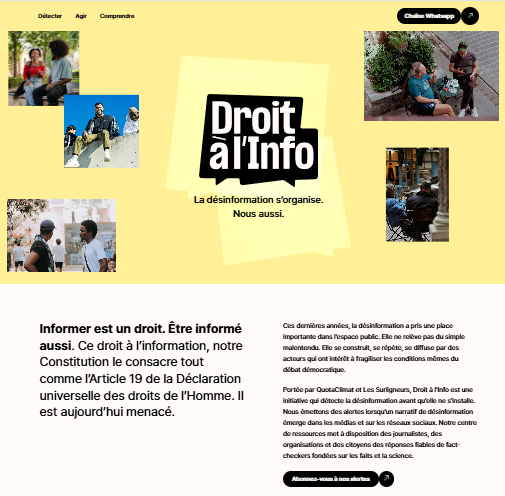
Informing is a right. Being informed is too. This right to information is enshrined in our Constitution, as well as in Article 19 of the Universal Declaration of Human Rights. Today it is under threat.
Droit à l’Info is the first initiative designed to stem disinformation as soon as it appears, end to end, from detection to alert.
In practice:
- Detect recurring narratives, using our technology
- Verify the facts, with our fact checking partners
- Assess the risk, because over reacting to disinformation is just as risky as under reacting
- Send out alerts, within 48 hours, to stem disinformation before it spreads
A few figures at a glance
Media coverage of environmental issues
5%
That is the average annual media coverage in France, a figure that is fairly similar between print and broadcast.
Agriculture, energy, and more: how does coverage break down by sector?
30%
The share of environmental coverage devoted to agriculture. It has become the most frequent angle.
15%
The same, but for energy. The second most prominent thematic angle, driven by debates around the energy mix and energy sovereignty.
5%
This time, the share for housing and land use planning. 5% of 5% is very little. That works out to 0.25% of airtime.
Putting environmental crises in context
75%
The share of articles that link heatwaves to climate change. Not bad, though the target could be 100%.
50%
The same figure, but for TV and radio segments. Lower, especially when you look at the results media by media.
La menace de la désinformation climatique
665
The number of climate misinformation cases detected in France in 2025, in the news programmes of broadcast media.
19
The number of distinct narratives in 2025, documented by the Observatory.
95%
The share of narratives observed in 2025 that already existed at the start of 2025 (and were therefore repeated and foreseeable).
1 cas
/ 30 minutes d’info sur le climat
The figure for SudRadio, the most prolific outlet when it comes to climate misinformation.
30%
The share of misinformation cases voiced by journalists on CNews and Europe 1.
Latest Data news
Climate misinformation as a systemic risk to information integrity in German media
This report is produced by the NGOs QuotaClimat, Science Feedback and Data For Good, as part of a collaboration aimed at semi-automatically detecting climate misinformation in the audiovisual media, through algorithmic pre-detection and manual validation. The project’s ambition is to produce …
Climate disinformation as a rising challenge for news media in France, Spain, Poland and Brazil
21 April 2026 – QuotaClimat, Data For Good and Science Feedback are publishing a new report on the state of climate misinformation on television and radio in four countries – France, Spain, Poland and Brazil – covering a total of 44 media outlets. Of the 815 instances of climate …

Belgium Launches an Environmental Information Barometer with QuotaClimat
The Belgian Environmental Information Barometer was officially launched on Monday, January 26 of 2026, with the presentation of its first results. Inspired by the French Observatoire des medias sur écologie , the project was initiated by the Conseil supérieur de l’audiovisuel (CSA) and the …

Mapping climate disinformation in French and Brazilian mainstream media
A few weeks before COP 30, the NGOs Data For Good, QuotaClimat and Science Feedback are releasing the findings of their new report mapping climate misinformation in audiovisual media. They warn that 529 cases have been detected in France over the past eight months. Without timely action from the …
The values that guide how we produce data
- Open source and auditability: all our work and methodology are made public. Methodological choices, limitations and biases are made visible and transparent. All the code we produce is available on GitHub (here and there in particular).
- Scientific rigour and expertise: QuotaClimat’s entire approach is presented to its scientific committee, which guarantees the neutrality and scientific rigour of our analyses. In addition, every project QuotaClimat contributes to (the Observatoire des Médias sur l’Écologie, the Baromètre Belge de l’Information Environnementale, Droit à l’Info) has its own independent expert committee. The goal: to maintain the highest standard of rigour in data production.
- Replicability by design: to make it possible to spread data production to other contexts (thematic or international), all technical infrastructure, and all methodologies, are designed from the outset to be replicable.
- Limiting AI: artificial intelligence is at the root of a number of impacts (social, environmental, disruption of the information space). We use it in a deliberately bounded way:
- Not using AI whenever a use case can be handled another way (semantic analysis, embedding models, and so on).
- Systematically quantifying the environmental footprint of each project.
- Using sovereign and/or open source/open weight models wherever possible.
- Reducing model sizes wherever possible.