
This report is produced by the NGOs QuotaClimat, Science Feedback and Data For Good, as part of a collaboration aimed at semi-automatically detecting climate misinformation in the audiovisual media, through algorithmic pre-detection and manual validation. The project’s ambition is to produce reliable, benchmark and open-source data on the presence of misinformation in the news media of the countries studied. The methodology is designed to be replicable, in collaboration with fact-checking organisations specialising in the national context under study. In this report, the accuracy of the data was verified through fact-checking by Klimafakten. This analysis focuses solely on mis- and disinformation regarding climate science and climate action, and does not cover all environmental issues, notably the crises relating to biodiversity or natural resources.
Climate coverage
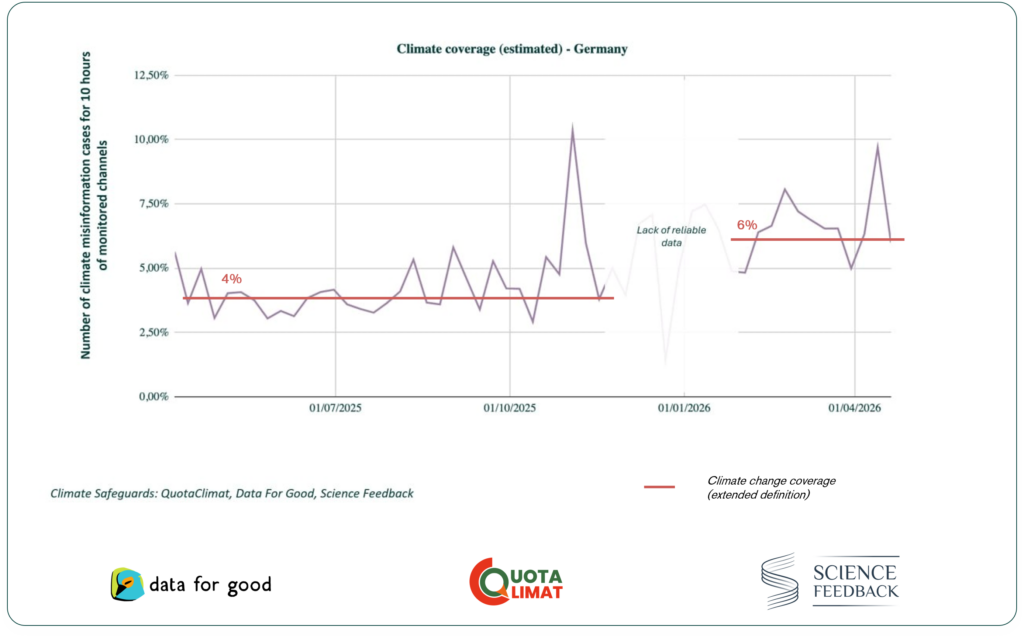
The analysis reveals an intra-year upward trend in climate coverage: from April to December 2025, it averaged between 2.5% and 5%, whereas from January 2026 onward, coverage rose to a range of 5% to 7.5% – excluding peaks.
An episodic coverage of climate-related information, with five peaks identified (beginning of November 2025; mid-December 2025; beginning of January 2026; beginning of March 2026; and mid-April 2026).
Distribution of climate-related news in Germany appears sensitive to on-going events, although not corresponding with the distribution of climate disinformation.
Distribution of climate misinformation cases
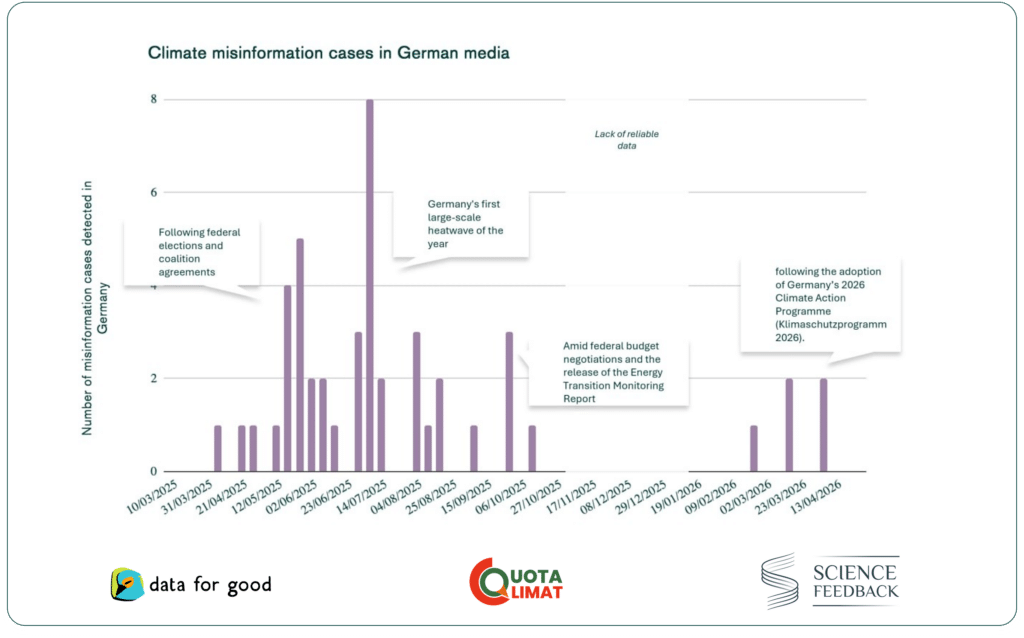
During the analysed period – April 2025 to April 2026 – a total of 47 unchallenged cases of misinformation were detected on the 6 German TV channels.
4 temporal clusters of unchallenged misinformation cases emerge:
- the last two weeks of May and first two weeks of June 2025, following the federal elections and coalition agreement;
- the first two weeks of July 2025, during Germany’s first large-scale heatwave of the year;
- the first week of October 2025, amid federal budget negotiations and the release of the Energy Transition Monitoring Report by the Federal Ministry for Economic Affairs and Energy (known in German as Monitoring-Bericht, “Die Energie der Zukunft”);
- In March and April 2026, following the adoption of Germany’s 2026 Climate Action Programme (Klimaschutzprogramm 2026).
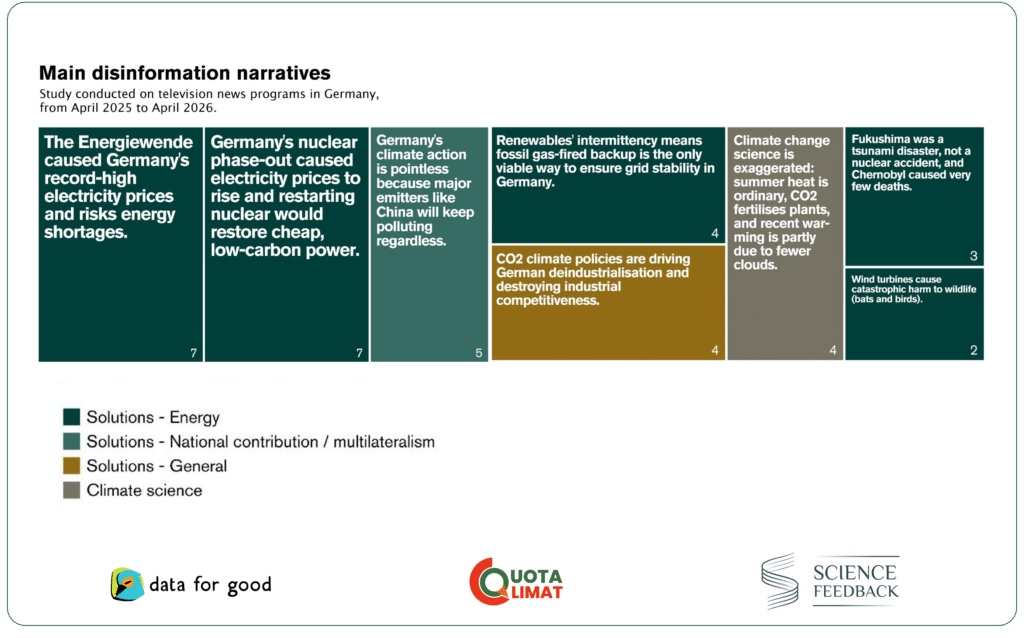
Most of the cases treat the energy topic, and more specifically, the Energiewende’s – and climate policy as a whole – economic and technical reliability. The rest fall into the topics of deflection of responsibility and climate science denial.
The breakdown of speakers
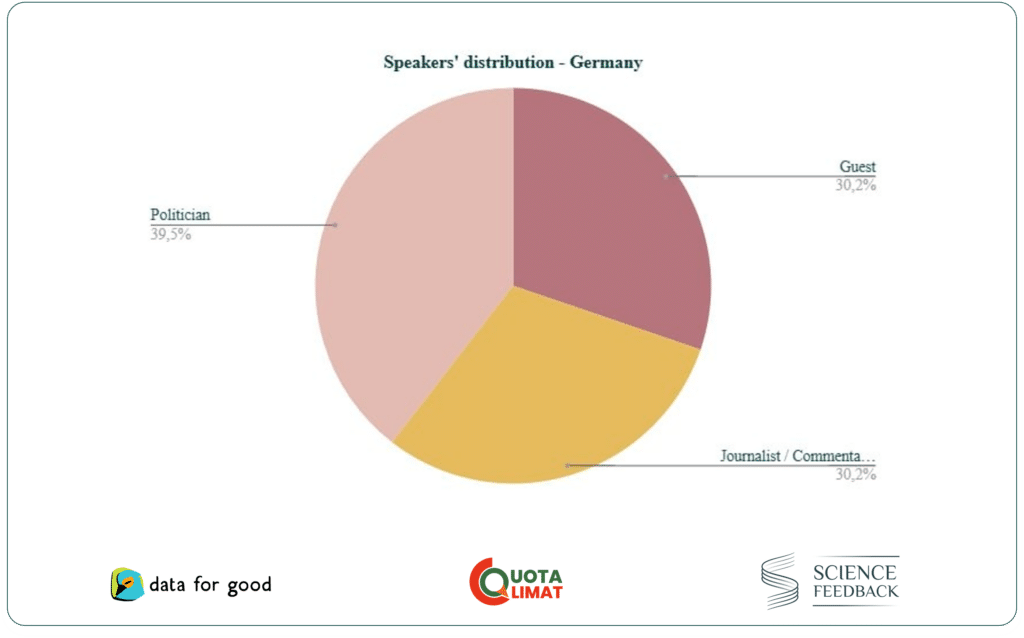
The breakdown of speakers’ identities is as follows:
- Politicians account for more than a third of the cases identified (39,5%);
- Journalists and commentators account for more than 30% of all cases;
- Guests represent 30,2% of this share.
In sum, external speakers remain the most active vectors of misinformation, with politicians and guests spreading 70% of misinformation cases. However, journalists and commentators rank high, representing almost 30% of cases spread, equally spread between public and private media
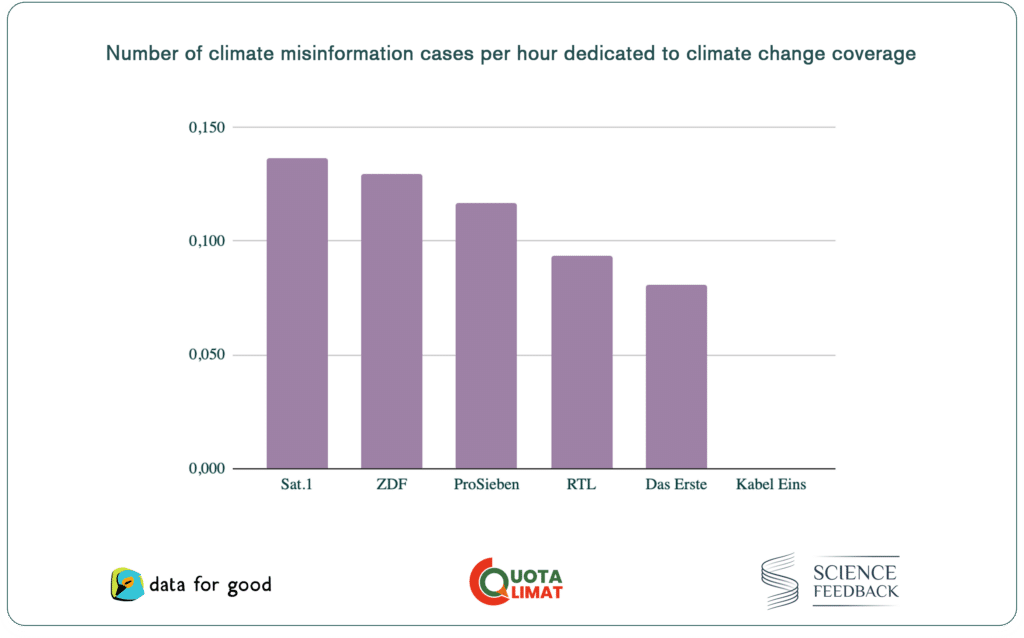
Sat.1 and ZDF emerge as the most exposed channels to climate misinformation. It is important to note precisely because they represent different cases within the German broadcasting spectrum: one a commercial private channel, the other the country’s first public broadcaster. Their shared vulnerability reflects two distinct mechanisms through which misleading climate claims gain access to mainstream primetime audiences.
Both private (RTL, Sat.1, ProSieben) and public (ZDF, Das Erste) media are equally exposed to climate misinformation cases, in contrast with other European countries such as France.
Four recommendations to strengthen the integrity of information
Recommendations include:
- Media practices: Improving media coverage of climate issues requires targeted journalist training, more balanced panel composition with live fact-checking mechanisms, and stronger editorial standards for environmental reporting;
- Independent oversight: A robust oversight framework should include stronger protections for journalists through the Anti-SLAPPs directive. Systematic monitoring of climate disinformation risks remains a critical gap to address;
- Funding and sustainability: Public press subsidies should be redirected toward supporting high-quality, independent media outlets to ensure the viability of trustworthy climate journalism.
- Strengthening societal resilience: Broader structural reforms are needed across several areas, and notably stricter lobbying scrutiny, tighter advertising regulation, media literacy initiatives and more effective oversight of big tech platforms, whose algorithmic systems significantly shape the public’s exposure to climate information
Scope and limits of the report
The analysis covers a 1-year period, spanning from April 2025 to April 2026. 6 German TV channels were analysed between April 2025 and April 2026: Sat.1, ZDF, ProSieben, RTL, Das Erste, and Kabel Eins. The perimeter does not include German 24-hour news channels (such as Welt, n-tv, and Tagesschau24).
For methodological purposes, journalists and commentators have been grouped under a single speaker category, though we acknowledge that these two functions do not carry the same level of professional responsibility and ethical obligation; this grouping instead reflects the broader presence of media practitioners and their varying degrees of exposure to, and potential spreading of misinformation.
The scope of this report does not include disinformation specifically relating to biodiversity.
Data collection relies on a network of partners, which can result in minor losses in the acquisition pipeline. The November 2025 – January 2026 period experienced a significant data loss (-80% of incoming flow). For this reason, that period could not be adequately analyzed, and no results for it are presented.