
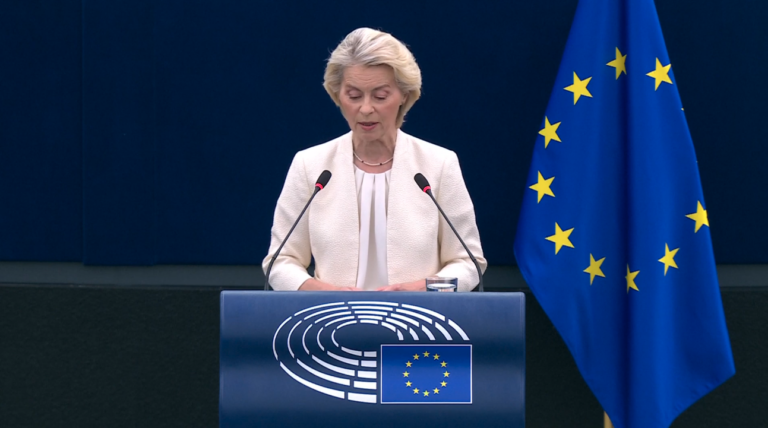
“A battle of narratives is seeking to weaken confidence in Europe; to paralyse our democracies.” This is how Ursula von der Leyen framed the stakes of her 2026 State of the Union address last Wednesday 16th of September. She was not talking, at that moment, about climate change. But she could have been.
The unnamed threat
This speech was, in large part, a speech about information integrity – even when it didn’t use the words. The President described a Europe confronting “cognitive warfare,” foreign interference, and a “decline of nuance” being weaponised to divide citizens from each other and from their institutions.
She announced a new Congress of Europe, pointed to the Centre for Democratic Resilience as already delivering results, pointed to the Centre for Democratic Resilience as already delivering, and called for a “counter-hybrid playbook.”
In the same breath, climate was one of the two “tipping points of our time,” alongside AI. Von der Leyen called this “the summer of truth” and was categorical: “Europe is warming at double the global rate.” She was equally clear on the response – “Europe can, must and will stay the course on its climate targets” – and previewed a new climate resilience framework built around 100 of the most vulnerable territories in Europe, plus a forthcoming European Heatwave Plan. On energy, she put a number on the cost of inaction: since the start of the war in Ukraine, “imported fossil fuels have cost us an additional €90 billion, without a single molecule of energy added.”
What’s missing is the connective tissue. Climate disinformation, the deliberate distortion of climate science, solutions and institutions, is never named as the hinge between these two threats.
That blind spot is structural: it still has no clear definition or systemic-risk status in the EU’s core security, media and digital frameworks, from the DSA to the Media Board’s draft strategy.
Why it matters
- Economic competitiveness: disinformation campaigns target precisely the terrain von der Leyen wants to secure – clean, homegrown energy and investment in the transition. Our data shows that disinformation campaigns overwhelmingly target precisely this terrain: over 90% of the climate misinformation cases identified attacked net-zero solutions – 70% of them the energy sector specifically according to our most recent study.
- Industrial and security strategy: responsibility for climate disinformation is scattered across Kallas, McGrath, Virkkunen, Lahbib, DG CLIMA, DG COMM, HOME, RPD, CONNECT, the Centre for Democratic Resilience and the EEAS, with almost no coordination between them. Poland’s disinformation working group found up to 30% of official documents it reviewed affected by Russian-linked disinformation, with climate among the most exposed topics.
- Public trust: 85% of Europeans still see climate change as a serious problem and back the 2050 neutrality target (Eurobarometer), but nearly half struggle to tell reliable climate information from disinformation online – even as the President warns of a broader “decline of nuance” and a public “no longer able to relate to each other” the way it once did
Why we document
Documentation is a lever, not an end in itself. Measuring which narratives circulate, where, how often, and who amplifies them makes three things possible:
- Institutions gain the evidentiary basis to act. EU legal experts argue the DSA’s systemic-risk obligations (Art. 34–35) apply to platforms’ amplification of climate disinformation, not just individual content – an argument that only holds with data behind it. The European Board for Digital Services’ first reports mark a step: DSCs are starting to treat climate disinformation as a systemic risk within crisis-related information ecosystems.
- Media and fact-checkers can act on evidence, not intuition. This is the same logic behind the President’s position on the New Center for Democratic Resilience – institutions can only “anticipate, detect and respond” to what they can first measure.
- Civil society and citizens can exercise their right to information – without tipping into censorship of lawful, if erroneous, speech.
What the data shows, at home
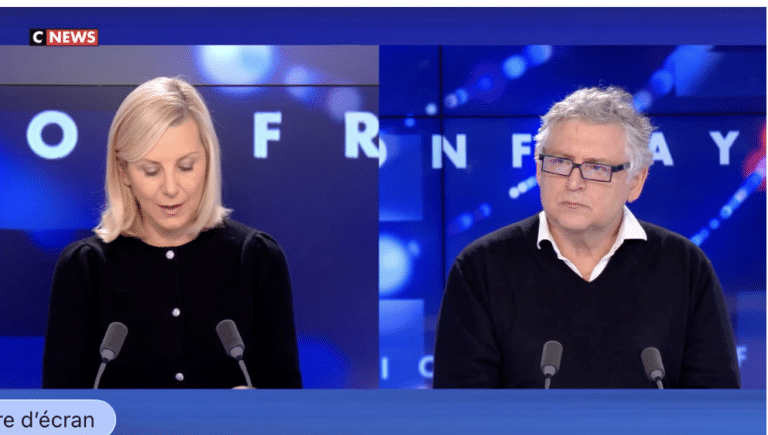
Our Observatoire des Médias sur l’Écologie (OMÉ) tracked 452 cases of climate misinformation across French audiovisual media in the first half of 2026 – an average of 17 per week, up 28% on the 353 cases recorded in H1 2025.
Heatwaves were flashpoints: 60 cases in the last week of May, 80 in the last week of June – the second-highest weekly total since monitoring began. Three outlets, CNews, Europe 1 and Sud Radio ,still broadcast more than one case per hour of climate-related airtime. Misinformation is disproportionately carried by political guests (31%) and other guests (27%); where journalists themselves are the source (20%), 70% of those cases are concentrated on just two channels, CNews and Europe 1.
What we’re asking for
The EU isn’t starting from zero – the DSA, Green Claims Directive, EMFA, Anti-SLAPP Directive and AVMSD (up for revision in December 2026) already form a real toolbox. What’s missing is coherence. Building on yesterday’s speech:
- Name it – an explicit, risk-based definition of climate disinformation as a typological tool, applied consistently under the DSA, the Code of Conduct on Disinformation and the AVMSD.
- Resource the monitoring gap – EDMO, the EEAS, the Strategic Task Force on Information Manipulation, Digital Services Board and the Media Board still lack AI-assisted detection tools to track climate narratives at scale.
- Connect the dots institutionally – the Centre for Democratic Resilience, DG CLIMA’s #ClimateFactsMatter campaign need a shared evidence base to add up to more than parallel pilots.
Europe, the President said, cannot change the course of events when it is divided. The same is true of an information environment documented in fragments. QuotaClimat exists to close that gap – and we’ll keep publishing what we find.